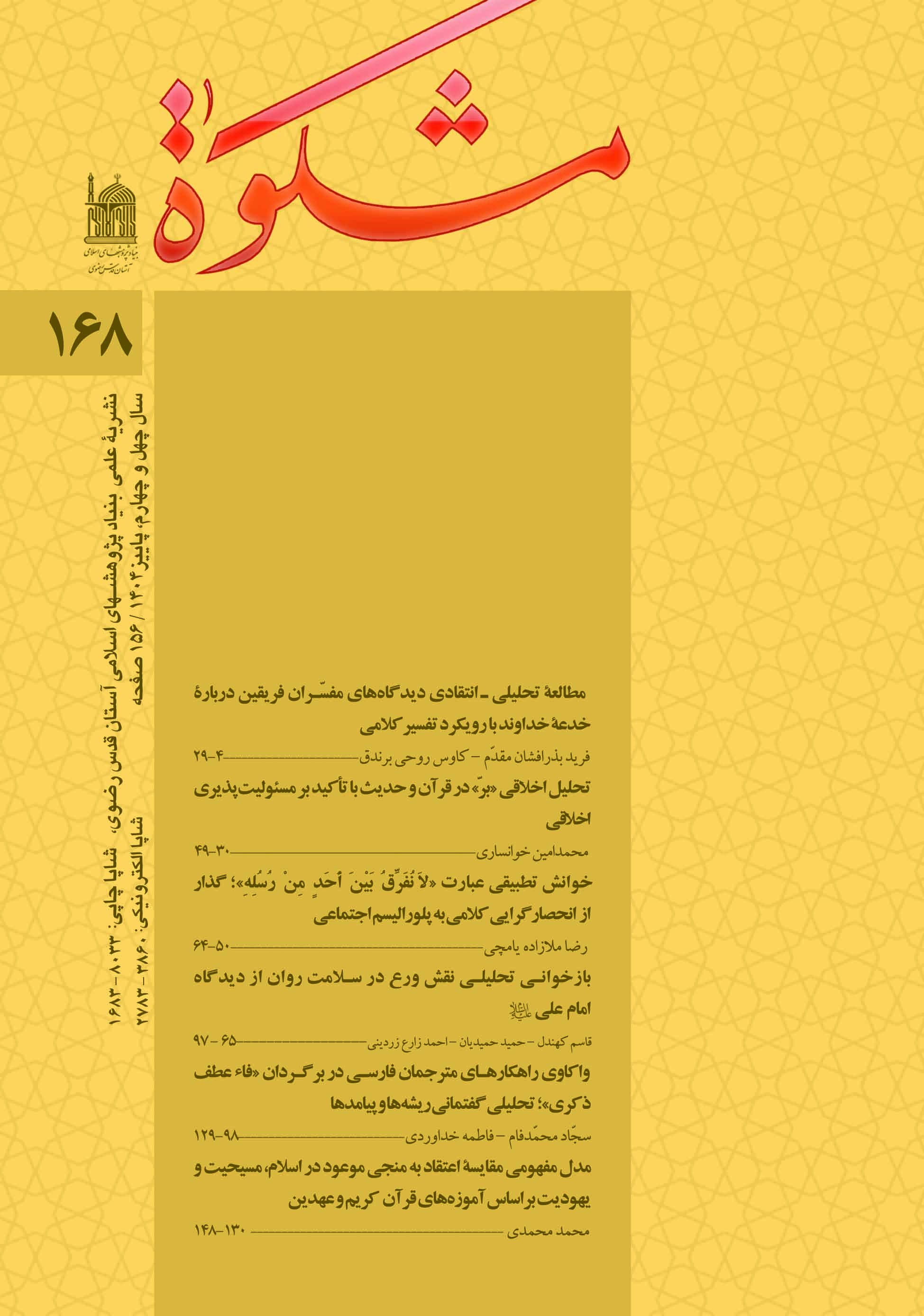
نوع مقاله : علمی _ پژوهشی
عنوان مقاله English
نویسندگان English
This study aims to investigate the strategies employed by Persian translators for rendering the "explicative fā’" in the Holy Qur’an, and explores its discursive consequences. This conjunctive particle, whose main function is not to express sequence but to create an explanatory and hierarchical architecture ("detailed inflection on the general"), is considered a fundamental challenge for translators due to the lack of equivalent in Persian. Using a descriptive-analytical method and a comparative discourse analysis approach, three key verses in contemporary Persian translations have been examined. The findings show that the dominant strategy is not "sequencing" (validating) with "then", but "equating" with "and". This strategy leads to the phenomenon of "discourse leveling" that reduces the hierarchical structure of the source text to a linear structure. Minority strategies also include "sequencing" (leading to validating) and the successful strategy of "preserving detail" (by removing the link or commentary "which"). The first two phenomena lead to "rhetorical reduction" and the loss of the expressive art of the original text. Consequently, the successful recreation of the rhetorical architecture of this structure requires a functional translation in which the translator, as a discourse analyst, instead of finding a lexical equivalent, reconstructs the explanatory function of the source text with appropriate target language tools, such as the "chapter" and the commentary "which".
کلیدواژهها English